How to detect heat exchanger fouling in petrochemical equipment
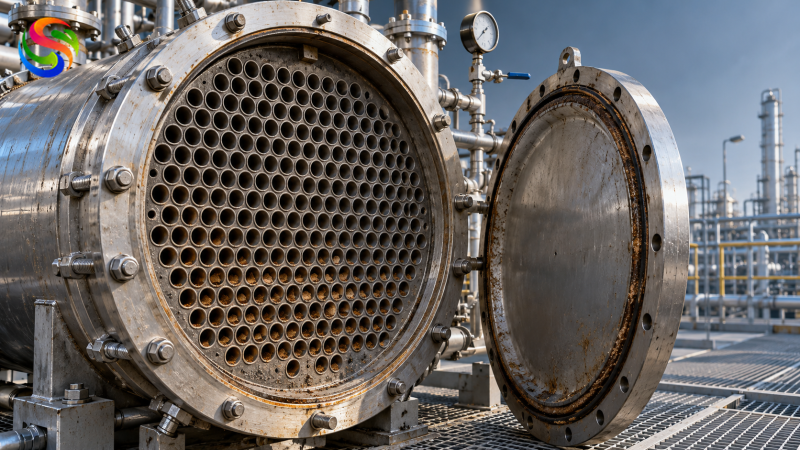
How to detect heat exchanger fouling in petrochemical equipment
Is your heat exchanger losing efficiency, or are changing operating conditions masking the real problem? In Petrochemical Equipment, a warmer product outlet does not automatically mean fouling. Feed temperature, cooling-water supply, valve position, and throughput can all shift performance. Reliable diagnosis starts with comparing thermal and hydraulic trends against a clean-equipment baseline under comparable conditions.
Establish a baseline you can actually use
Use commissioning records or readings taken after verified cleaning. Record inlet and outlet temperatures, flow rates, and exchanger-side pressure drops for both fluids, along with fluid composition and operating conditions. A baseline without flow data is weak evidence: reduced cooling-water flow can resemble deposit buildup.
Before trusting the trend, check temperature sensors, pressure impulse lines, and flow-meter readings. Plugged pressure taps or drifting instruments can send a maintenance crew toward an unnecessary shutdown. Compare readings during stable operation, not startup or a feed change.
Read heat transfer and pressure drop together
Calculate heat duty from measured mass flow and enthalpy change. For single-phase streams with limited property variation, Q = m × Cp × ΔT is a useful approximation. Compare hot-side and cold-side duties; a substantial mismatch warrants checking measurements, heat losses, or possible leakage before diagnosing fouling.
Then estimate the overall heat-transfer coefficient using U = Q / (A × F × LMTD), where F is the applicable temperature correction factor. Use consistent area definitions and account for changes in flow and fluid properties. Falling U supports a fouling diagnosis, but lower velocity can also reduce U without deposits.
- Declining corrected thermal performance plus rising pressure drop on one side strengthens the case for deposits restricting that flow path.
- Declining thermal performance with little pressure-drop change can indicate a thin insulating layer; do not rule out fouling.
- A sudden performance change calls for checks of bypass valves, strainers, pumps, and utility supply before assuming gradual deposit growth.
Compare pressure drop at similar flow and viscosity, using exchanger pressure taps rather than readings across an entire piping circuit. Otherwise, a blocked strainer or partly closed valve may look like tube blockage.
Confirm the cause before choosing a cleaning method
If trends remain consistent with fouling, plan inspection around operating limits and the consequences of lost duty. There is no universal percentage loss that justifies cleaning. Consider available utility capacity, product temperature requirements, pressure-drop limits, and the rate of deterioration.
After isolation, depressurization, draining, and site-required decontamination, inspect accessible surfaces and collect deposits for analysis. In steel tubes and connected piping, corrosion products may signal active metal loss, not merely dirt. Select suitable thickness or tube-integrity testing where indicated. Cleaning chemistry must suit the deposit, tube alloy, seals, and disposal requirements.
Keep the exchanger record linked to connected-component specifications. Xingyuan Fluid Systems Co., Ltd. supplies petrochemical pipelines, valves, flow meters, pumps, and steel pipe fittings; accurate material and component records help support troubleshooting across these interfaces. After cleaning, repeat the baseline measurements. If performance does not recover, investigate incomplete cleaning, flow maldistribution, or mechanical damage rather than immediately repeating chemical treatment.
Please give us a message