
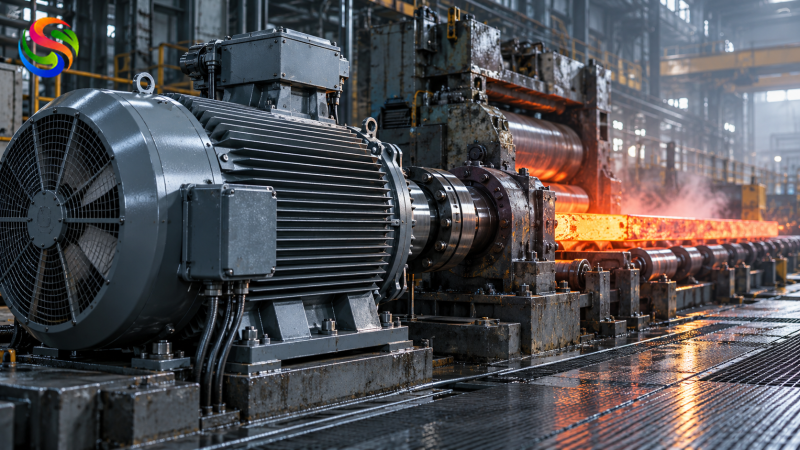
Why do electric motors overheat at low speeds on rolling mills?
Electric motors on rolling mills often overheat at low speeds because cooling airflow falls while heavy rolling loads continue generating substantial heat inside the windings.
Rated current alone does not guarantee safe operation. Maintenance teams must compare actual torque, cooling performance, and operating duration against the motor’s permitted speed range.
Start by identifying whether overheating follows sustained low-speed rolling, occurs across all speeds, or concentrates around bearings. Each pattern points toward different checks and remedies.
Why does low speed create a cooling problem?
On self-ventilated motors, the shaft-mounted fan slows with the rotor. Airflow decreases, reducing heat removal precisely when rolling torque may remain high for extended periods.
Many rolling duties require approximately constant torque. Consequently, current and copper losses can remain significant even though shaft speed and mechanical output power are lower.
Check the manufacturer’s continuous torque-versus-speed curve and cooling arrangement. A motor’s nameplate rating does not automatically permit continuous full torque at every drive frequency setting.
Check airflow before changing drive settings
Under safe isolation procedures, inspect fan blades, guards, cooling fins, and ventilation passages for mill scale, oil deposits, damage, or obstructions that restrict heat transfer.
For separately powered blowers, verify operation, rotation direction, filter condition, and airflow. Confirm that blower failure alarms and interlocks actually protect the main motor during operation.
Record ambient temperature near the cooling inlet. Hot recirculated exhaust air can undermine an otherwise functioning fan, especially inside crowded motor rooms or enclosed installations.
Is excessive torque keeping current high?
Trend motor speed, torque estimate, current, and winding temperature through a representative rolling cycle. Include threading, loaded crawling, repeated acceleration, and delays between successive passes.
Inspect for tight bearings, coupling misalignment, gearbox problems, and abnormal roll resistance. Compare similar products and pass schedules before attributing increased current to motor failure.
Repeated overloads or prolonged stalled conditions require immediate investigation. Increasing thermal trip limits can hide excessive heating and accelerate insulation deterioration without correcting its cause.
Which electrical checks are useful?
Review drive control mode, motor nameplate entries, commissioning results, and low-speed compensation. Excessive voltage boost can increase heating; inadequate control can produce unstable torque delivery.
PWM supply adds losses that vary with motor design and drive configuration. Follow manufacturer guidance before adjusting carrier frequency, output filters, or motor cable arrangements.
Have qualified personnel check phase-current imbalance, connections, and winding condition. Use instruments suitable for drive outputs; ordinary meters may give misleading readings on PWM waveforms.
Decide whether cooling or motor selection must change
If temperatures rise mainly during sustained low-speed loading, evaluate independent forced ventilation or an appropriately rated motor. Verify continuous torque capability at the required speed.
Where practical, reduce loaded crawling time or revise the duty cycle. Confirm any change against rolling quality requirements, production constraints, and the manufacturer’s thermal limits.
When requesting replacement electric motors, provide minimum operating speed, torque profile, overload duration, ambient conditions, drive details, and available cooling arrangements rather than power alone.
Confirm the repair under actual rolling conditions
Repeat a comparable production cycle and trend winding sensors, bearing temperatures, load, and blower status. Housing temperature alone cannot establish the temperature inside the windings.
Judge success against manufacturer limits and stable temperature trends. Reliable protection comes from matching cooling and motor capability to the actual low-speed duty cycle.